


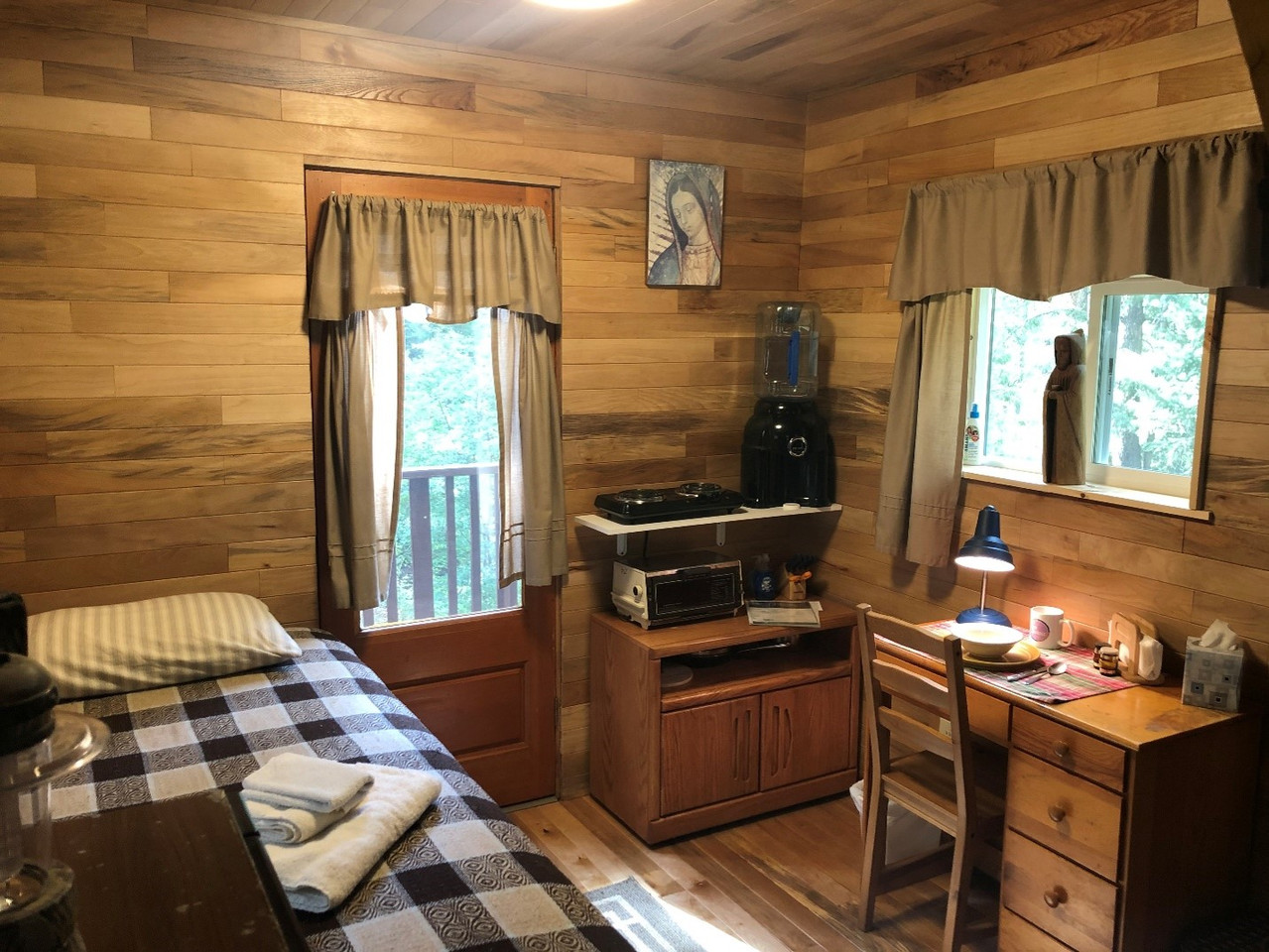
The Idea of a Desert
In Catholic tradition, the word “desert” carries a meaning that has little to do with sand. It describes a place set apart, deliberately emptied of distraction, where a person goes to pray alone and to meet God without an audience. Christ withdrew to such places. The early monastics went looking for them. Religious communities have been building and defending them ever since.
Regina Caeli Hermitage, in the foothills above Littleton, Colorado, is a desert in exactly this sense. It functions as the Desert House for the United States Region of the Brothers of Saint John, and understanding that role explains almost everything about how the property is run, from the strict guidelines to the deliberate absence of comfort in its prayer cabins.
What the Name Means
Regina Caeli is Latin for Queen of Heaven, one of the oldest Marian titles in Christian devotion and the name of the Easter antiphon sung in the Church’s liturgy through the paschal season. The choice of name places the Hermitage under Mary’s patronage and signals the Marian character of the spirituality practiced there.
The title is not merely decorative. The liturgical feast of Our Lady Queen of Heaven falls on 22 August, and the Hermitage community has traditionally gathered on the nearest weekend to mark it, drawing together the friends, volunteers, and benefactors who keep the property running. A place built around silence still needs, once or twice a year, to celebrate in company.
From the Upper Land to the Desert House
The Hermitage began with one priest and a conviction. Fr. Roger Mollison, a priest of the Archdiocese of Denver, started the project in the 1980s on land he called the Upper Land. His approach was modest and practical: he built small prayer cabins so that visitors could experience God’s love and mercy in silence and solitude. No campus, no marketing, just shelters placed in a quiet valley for people who needed one.
In 2002 the property passed to the Brothers of Saint John. The community finished the Dome House, the larger building Fr. Mollison had begun, and designated the Hermitage as the Desert House for the Brothers’ United States Region. What one diocesan priest started as a place for lay retreatants became, without losing that original purpose, a structural part of a religious congregation’s formation.
Two Months of Silence
The clearest expression of the Hermitage’s role is the novitiate desert. Each year, ordinarily from June to August, the novices of the Brothers of Saint John spend roughly two months at Regina Caeli in solitary prayer. During that window the Dome House is generally closed to outside groups, which is why the Hermitage’s booking calendar looks different in summer from the rest of the year.
The reasoning behind this is stated plainly in the congregation’s own governing texts. In order to safeguard the demands of contemplative life in the middle of an active apostolate, the Congregation of Saint John commits itself to preserving places of desert where the Brothers can live the mystery of Jesus’ solitary prayer, His adoration, and His contemplation. These deserts are described as a hidden pearl to be guarded jealously, where each Brother discovers the bond uniting his heart to the Hearts of Jesus and Mary.
The language is worth noticing. The commitment is not to occasional quiet time as a wellbeing measure. It is a structural safeguard written into the identity of the congregation, on the understanding that an apostolic community which stops praying in solitude will eventually stop being able to give anything worth receiving.
The Community Behind the Property
The Brothers of Saint John were founded in Switzerland in 1975 and take their inspiration from the Beloved Disciple. Their life rests on four commitments held together: prayer, study, fraternal charity, and teaching and preaching. Contemplation and active ministry are not treated as competing claims but as two halves of a single vocation, which is precisely why a place like Regina Caeli is necessary rather than optional.
The community has established priories across the United States, including in Princeville, Illinois; Laredo, Texas; Orange, New Jersey; and Denver, Colorado. Alongside their own formation and retreat work, the Brothers have been invited into parish life in several locations, serving at Our Lady of Mount Carmel in Orange, New Jersey, and at St. Ignatius of Loyola in Denver. The Hermitage is stewarded by a member of the community, and successive Archbishops of Denver have publicly acknowledged the Brothers’ ministry within the archdiocese.
What the Desert Offers Everyone Else
A place reserved for the formation of religious novices could easily have become closed to outsiders. Regina Caeli went the other way. Outside the desert months, the Hermitage is available to groups and individuals who want to make a retreat in a silent and peaceful place, and the guidelines that govern those stays are the same ones that protect the novices’ solitude.
This is the quiet logic of the property. Retreatants are not renting a facility that happens to be religious. They are borrowing a desert that a community has spent decades building and defending, and the atmosphere they encounter is a direct result of that. The prohibition on televisions and radios, the request to stay on the paths, the insistence that the Hermitage is not a hotel: each rule exists to keep the silence intact for whoever needs it next.
The Scripture the Brothers place at the head of the Hermitage’s pages, drawn from the Gospel of Mark, is an invitation to come away to a lonely place and rest a while. It reads less like a slogan than a job description.
Keeping the Desert Alive
Maintaining a contemplative property in the Colorado foothills is unglamorous work. The Brothers’ ongoing projects include repairing the access road, building additional prayer cabins, and improving the grounds and installations so that guests are properly received. All of it is funded through donations from retreatants, volunteers, and friends of the Hermitage rather than through commercial rates.
The suggested contributions for a stay are modest and explicitly flexible, on the principle that no one should be turned away for lack of means. That decision costs the community something, and it is made anyway, which tells a visitor a good deal about what the Hermitage is for.
A Hidden Pearl, Still Hidden
Regina Caeli Hermitage is unlikely ever to be famous, and the Brothers seem entirely comfortable with that. Its value lies in what it refuses to become. In a state full of places selling mountain views, here is a valley kept deliberately empty so that a novice can pray for two months without interruption, and so that a stranger arriving in September can hear something other than their own noise.
The congregation calls its deserts a hidden pearl. Regina Caeli, sitting quietly off Deer Creek Road with inconspicuous signage and no ambition to expand, is a fair illustration of what that phrase means in practice.

